Why Conversation English Practice Helps Kids in Nha Trang Speak Up
At 5:30 p.m., the sun still hits Tran Phu Beach, and families line up for corn and coconut water while tourists stroll past with sandy feet. A child hears "Hello!" from a visitor and looks at their parent like, "Please answer for me." That small freeze happens a lot with conversation English Nha Trang children - even kids who score well on school tests. If you want your child to speak with more ease, you do not need louder lessons. You need smarter practice, and you can start this week.

The Real Question
Most parents do not really ask, "Which textbook is best?" They ask:
"My child studies English. Why do they go quiet in real conversations - and what can I do?"
That is not a lazy-child problem. It is a practice problem.
What Most Parents Get Wrong About Conversation Practice
The surprising truth: more vocabulary and more grammar do not automatically create better speaking. Sometimes they slow your child down.
In real conversation, your child cannot pause and build a perfect sentence like they do on a worksheet. They must listen, choose a simple reply, and keep the conversation moving. If they try to translate in their head, they fall behind and feel stuck.
Here is a scene I hear about all the time:
Scenario 1 (after school): Your child comes home in the late afternoon, tired from a long day and extra homework. You ask, "What did you eat today?" in English. They know "rice," "noodles," "chicken." But they still answer in Vietnamese, or they say, "Good," and stop. When you push, they smile awkwardly and look away.
Your child is not "forgetting English." They are missing the micro-skills that make English conversation practice for children work:
- answering fast with a simple sentence
- using a "rescue phrase" when they forget a word
- staying calm when they make a mistake
- asking back instead of waiting for the next question
School English often trains kids to avoid mistakes. Conversation trains kids to continue anyway. That difference explains why classroom English and real-life English feel like two different languages.
The SURF Conversation Framework
I use a simple framework to build speaking step by step. It works for ages 4-15, and it fits real moments around Nha Trang. I call it the SURF Conversation Framework - because kids learn conversation like they learn to handle waves: small, repeatable practice with support.

S - Set the Scene (Safety + One Tiny Goal)
Before your child speaks, set a small goal they can finish in under two minutes.
- "Say hello + one question."
- "Order one drink politely."
- "Use one feeling word."
Also give them a safety net: one phrase they can use when they get stuck.
Kid-friendly safety phrases: "One moment..." "Again, please." "How do you say...?"
Small goal + safety phrase = less pressure, more speaking.
U - Understand the Message (Listen for Meaning)
Kids often listen like they take an exam. They try to catch every word, and they panic when they miss one.
Teach your child to listen for meaning:
- Who is talking?
- What do they want from me?
- Which word do I recognize?
Then give them permission to answer with what they do understand.
If someone asks, "Do you like...?" your child can say "Yes, I do" or "Not really" even if they miss the last word. That is not cheating. That is real conversation.
R - Respond with a Bridge (Short Answer + Keep the Turn)
Your child does not need long answers. They need bridges that keep them speaking.
Teach three tools:
- Short answer: "Yes, I do." "I am nine." "Not today."
- Bridge phrase: "Because..." "I think..." "My favorite is..."
- Hesitation tool: "Let me think." "I forgot the word." "Can you repeat?"
These tools build speaking confidence children can feel immediately because they stop getting stuck on empty.
Scenario 2 (in a speaking group): A teacher asks, "What did you do on Sunday?" A child wants to say they went swimming but forgets "swim." Instead of freezing, they say, "I went to the beach and..." (mimes swimming). The teacher supplies the word. The child repeats it and finishes the sentence.
That one repair teaches a powerful habit: do not quit - fix and continue.
F - Follow Up (Ask Back + Extend)
Conversation becomes real when your child asks back. Follow-ups also help shy kids because they shift attention from "me performing" to "us talking."
Start with easy follow-ups:
- "And you?"
- "What about you?"
- "Why?"
- "Which one?"
Then add one extension:
- "I like mango. Mango is sweet."
- "I went to Vincom. I bought a notebook."
This step builds turn-taking and listening skills - core English communication skills Vietnam kids rarely practice in school. Then take ten seconds to reflect: "What was easy?" "What word did we miss?" Reflection makes the next conversation smoother.
For pronunciation support without drilling, see simple pronunciation practice for kids in Vietnam.
Conversation English Nha Trang Children: What Makes It Different Here
Nha Trang gives kids English exposure, but not always English practice.
You hear English near Tran Phu, in cafes, at the night market, and in hotel lobbies. During busy travel seasons, kids may get friendly questions like "Where are you from?" or "Do you like Nha Trang?" from visitors.
But most street conversations here are:
- short
- noisy
- full of distractions (heat, scooters, crowds, dripping ice cream)
That is why "Just talk to tourists!" does not work as a plan. It can even backfire if your child feels pressured in front of strangers.
Local routines matter too. Many children switch between school shifts and extra classes. By evening, their brain wants rest, not performance. And during the rainy months (often around October to December), families stay indoors more, so kids lose natural speaking moments.
So yes, Nha Trang offers chances. But your child still needs a place - and a method - to practice conversation in a calm, repeatable way.

How to Find Good Conversation Practice Opportunities in Nha Trang
When you choose a conversation class, club, tutor, or playgroup, focus on what your child does during the time. For a broader overview, see English Speaking Classes in Nha Trang for Kids: A Complete Guide.
1) Make sure your child gets many speaking turns
Ask: "In a 60-minute session, how many times will my child speak?" More turns beat longer lectures.
2) Look for real back-and-forth
Good practice includes pair work, small-group talk, and follow-up questions - not only repeating after the teacher.
3) Check the correction style
Strong conversation practice corrects lightly:
- let the child finish the idea
- fix one small thing
- let the child try again
Too much correction teaches kids to fear mistakes.
4) Notice emotional safety
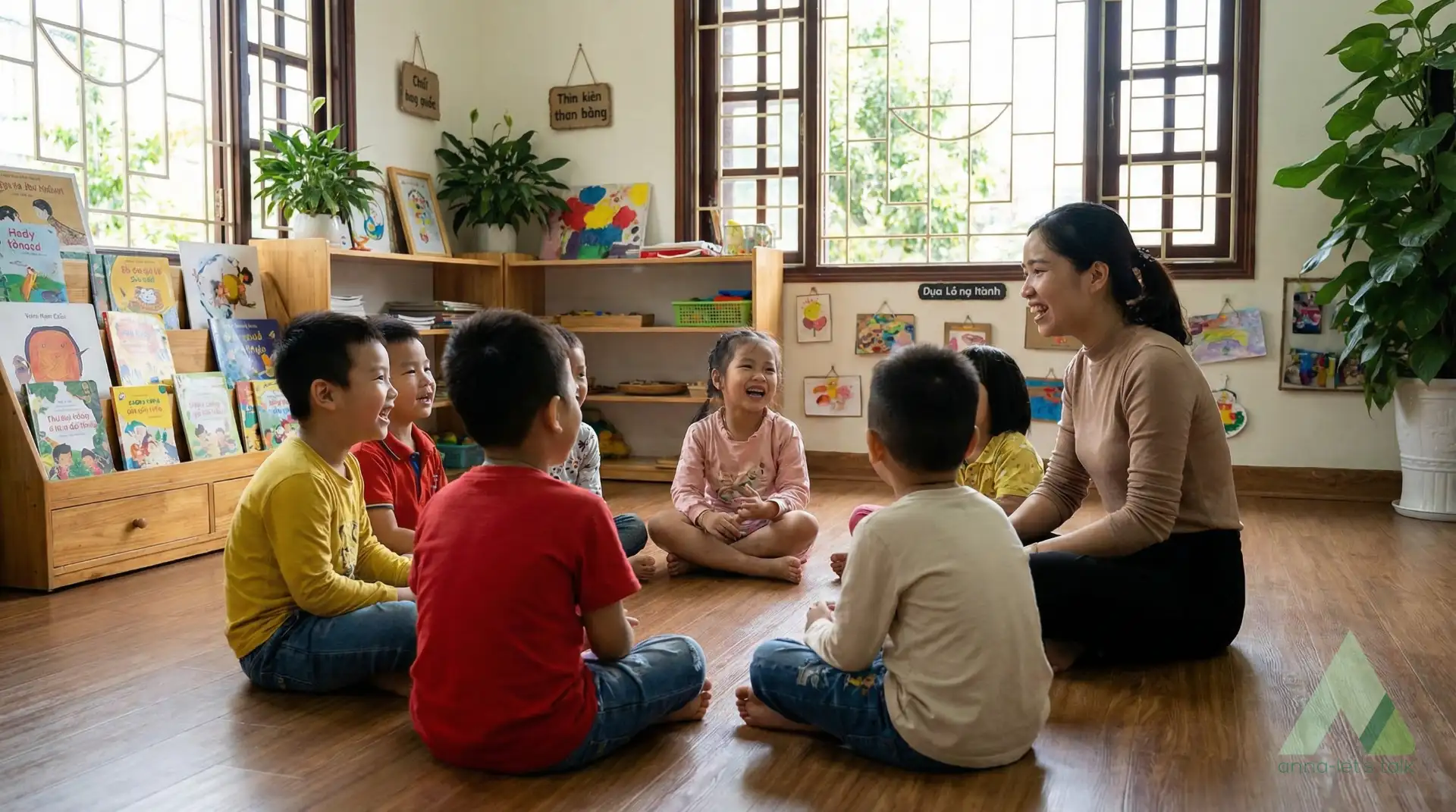
Kids speak when adults smile, wait, and accept imperfect English. If the room feels tense, speaking will shrink.
5) Match the level and the personality
A shy 6-year-old needs a different group than a confident 12-year-old. Ask how the teacher balances quiet and talkative kids. If you are unsure, start with English speaking classes in Nha Trang for kids and use the observation tips to find the right level.
How Parents Can Support Conversation English at Home
You do not need perfect English. You need small routines that fit your family's Nha Trang schedule. Pick two ideas and repeat them all week.
- 60-second beach recap: "I saw... I ate... I played..." (three sentences only)
- Same question every day: "What was the best part today?" (easy pattern, deeper answers)
- Rescue-phrase practice: teach 3 phrases and praise your child when they use one
- Two-turn dinner talk: you ask one question, your child answers and asks "And you?"
- One sound a week: practice /th/ or final sounds for one minute, then use them in a sentence
- Rainy-day role play: "order food," "ask for directions," "buy fruit" using toys or paper money
- Before-you-go-out practice: two tourist-style questions before the night market or a cafe
- 15-second voice notes: your child sends you a voice message: "Today I..." and you reply with one question
- Daily choice moment: "Mango or banana?" "Beach or pool?" (real decisions in English)
- Five-minute conversation walk: early morning when the air feels cooler - stop after five minutes on purpose
These habits grow kids speaking skills Nha Trang parents want because they train real-time speaking, not silent studying. If you want more ideas, see raising bilingual kids in Nha Trang beyond the classroom.
FAQ
1) My child understands English but answers in Vietnamese. What should I do?
Keep questions short and predictable, and ask for a tiny English answer first ("One sentence"). Add rescue phrases so your child does not panic when they forget a word.
2) Should I correct mistakes during conversation?
Not every time. Let your child finish, then fix one small thing and model the better sentence. Too many corrections can hurt confidence.
3) How often should my child practice conversation?
Short and frequent works best. Aim for 5-10 minutes most days, plus one longer speaking session each week if you can.
4) My child is shy. Will conversation practice help?
Yes - if the environment feels safe. Shy kids do well with small goals, partner work, and lots of wait time. Avoid pressure and public forcing.
5) Should we focus on pronunciation or fluency first?
Do both, but keep it light. Let your child speak, then practice one sound or one stress pattern. Clear speech builds confidence because people understand them.
6) Can beginners do conversation practice, or do they need more vocabulary first?
Beginners can start immediately with "survival English" (hello, please, I want, again, help). Speaking helps words stick because kids use them in real moments.
Gentle Closing + Soft CTA
If your child freezes, do not label them as "bad at English." They simply have not practiced the real skill yet: listening, answering, repairing, and continuing.
If you want a calm place to practice these skills in town, see our English speaking classes for kids in Nha Trang at Anna Let's Talk, with real conversation, pronunciation support, and gentle feedback. You are welcome to observe a session or let your child try a speaking-focused class and see how they feel. That kind of practice is exactly what conversation English Nha Trang children need to speak up in daily life.