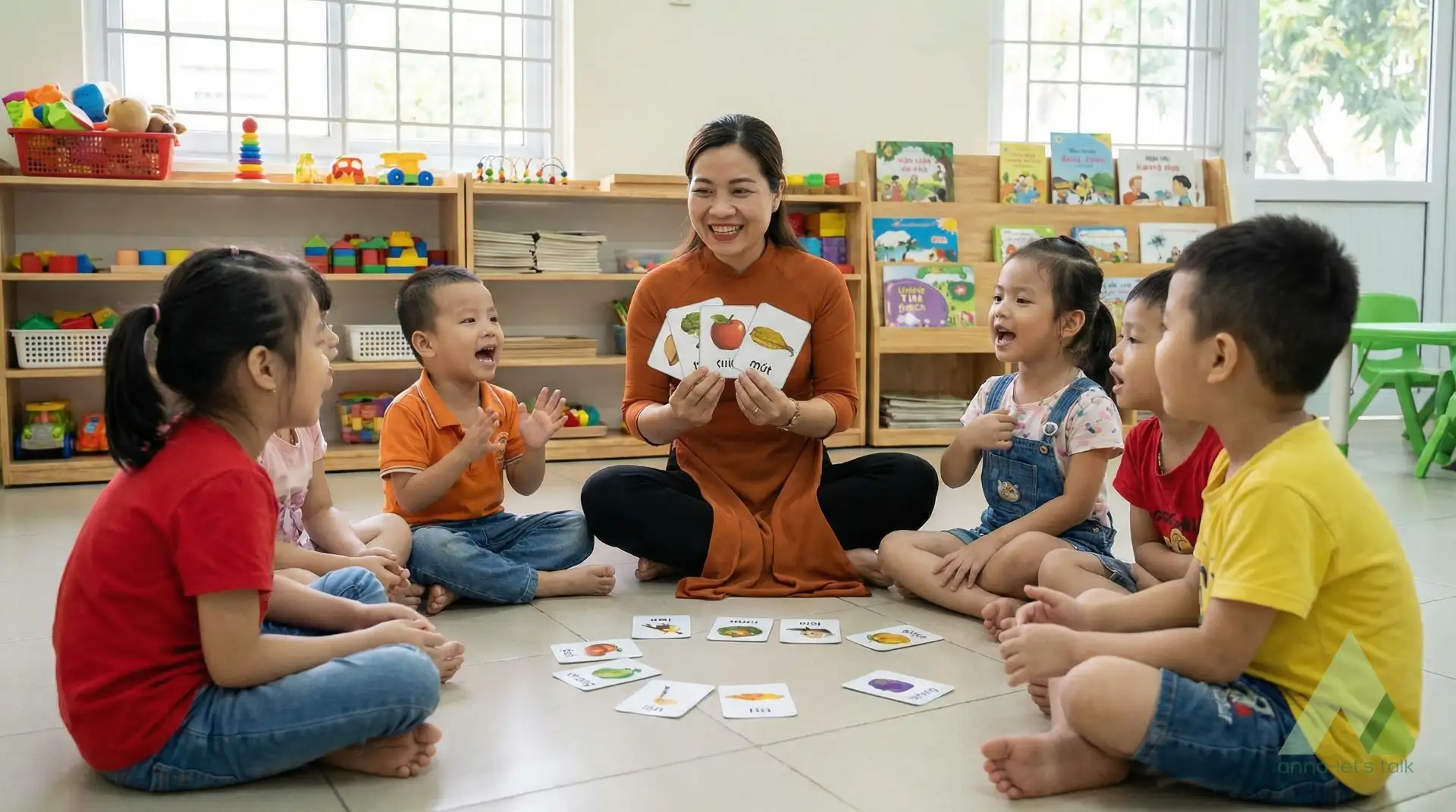
English Speaking Classes in Nha Trang for Kids: A Complete Guide
At 5:30 pm on Trần Phú, the air still feels warm, scooters stream past the beach, and kids in uniforms head home for dinner. You ask, "Tell me one thing you did today in English." Your child smiles, thinks, and says, "Umm..." If you are searching for English speaking classes Nha Trang kids can take after school, you want real conversation, not more copying and tests. This guide shows you how to judge speaking classes in Nha Trang and gives practical steps you can use at home.

The Real Question
A lot of parents mean this when they say "speaking class":
"How do I find a class where my child (4-15) will actually speak, feel confident, and sound clear - not just memorize a script?"
What Most Parents Get Wrong About "Speaking Classes"
Here is a counterintuitive truth: the best speaking classes can look repetitive and "too simple" at first.
Many parents expect a new topic every lesson and big speaking performances. But kids do not become speakers by collecting more words. They become speakers when they can pull out small, useful phrases quickly, with clear pronunciation, in many situations.
Repetition builds that speed.
Think about how Nha Trang kids live: school all day, homework, a snack, then an evening class while the city stays noisy and hot. When a child feels tired, their brain will not perform. A good speaking class lowers the pressure and builds automatic language through short practice cycles.
A quick classroom moment you might recognize:
A 9-year-old reads a dialogue about "My hobby is swimming." Then the teacher asks one real question: "Why do you like it?" The child freezes. The child does not lack vocabulary. The child lacks a speaking bridge - a simple way to start and connect ideas under pressure ("I like it because...").
For a closer look at building that bridge, see conversation English practice in Nha Trang.
Another thing parents often miss: correction timing matters more than correction amount. If a teacher stops a child every few words, the child learns, "English = mistakes." A stronger class lets the child finish the message, then helps them say it cleaner on the next try.
The Sandcastle Speaking Framework
I use this simple framework to explain what effective speaking practice looks like. It fits ages 4-15, and it matches real life here by the sea.
I call it the Sandcastle Speaking Framework: kids build speaking one layer at a time, then they test it against "real waves" (unexpected questions).
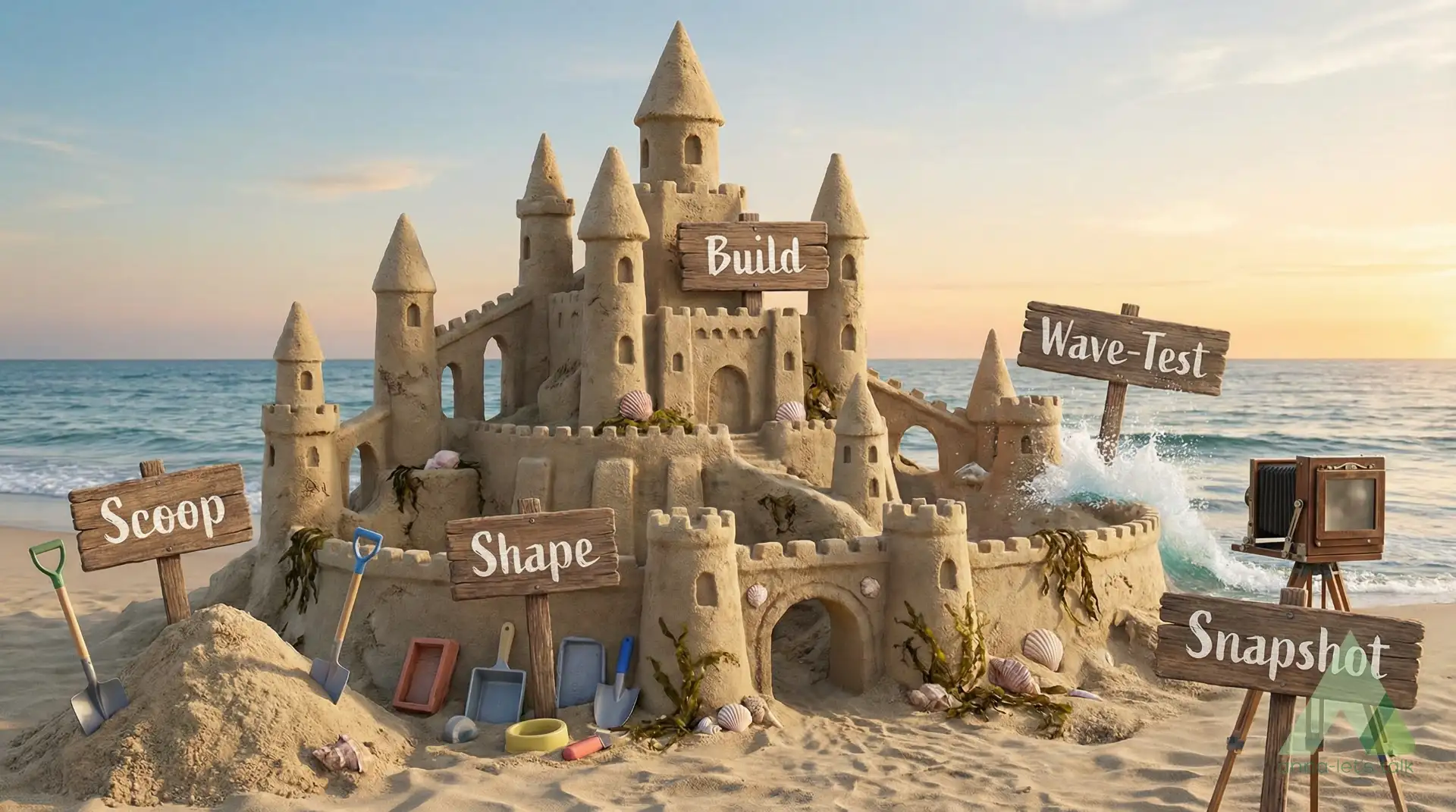
1) Scoop: collect ready phrases
Kids start with phrases they can use tomorrow, not random word lists.
- Younger kids: "I want...", "My turn", "Help me, please."
- Older kids: "I think... because...", "Can you repeat that?", "In my opinion..."
Nha Trang example: instead of "fruit vocabulary," a child learns one strong line: "Can I have a mango smoothie, please?"
2) Shape: make it easy to say
The teacher helps the child say the phrase clearly:
- split it into chunks ("Can I have / a mango smoothie / please?")
- fix one key sound (final sounds, /s/ vs /sh/, /th/)
- add natural rhythm (question intonation, sentence stress)
Clarity matters when your child hears mixed accents around town - tourists on the beach, expat parents at the playground, and different teachers across classes.
For a simple guide at home, see how to improve English speaking for kids in Vietnam and keep practice focused.

3) Build: practice with roles
Kids do not need long speeches. They need short role-play with fast switching: customer to staff, student to teacher, friend to friend.
A realistic classroom scenario: A shy 7-year-old whispers, "Can I have the blue one?" The partner understands and hands it over. The teacher says, "Good message. Now make 'blue' clearer." The child repeats it louder. That is progress.
4) Wave-Test: add one surprise
The teacher changes one detail: "Sorry, no mango - banana." / "Which size?" / "Why?"
Kids learn to keep going even when the script breaks. During tourist season in Nha Trang, this skill helps kids handle real English moments instead of freezing.
5) Snapshot: reflect in 60 seconds
Before class ends:
- the child chooses one sentence they said well
- the teacher gives one next step ("Add the final /t/," "Start with a full sentence")
- the child repeats the improved sentence once
Kids leave knowing what to do next time. That feeling builds confidence.
English speaking classes Nha Trang kids: how to choose the right fit
You do not need a "perfect" class. You need a class that matches your child and your weekly rhythm - school pickup, traffic near Lê Hồng Phong, dinner, then homework.
When you observe a class (even for 10 minutes), check these points. If you are planning a visit, use English tutoring for expat kids in Nha Trang as a quick checklist for what good speaking practice looks like.

Kids talk a lot, but in short turns
Look for pair work and small groups. In a 60-minute class, each child should get many chances to speak, not one long turn at the end.
Ask this simple question: "How many speaking turns does each child get in one lesson?"
The teacher listens like a coach
Listen for specific feedback:
- "Try that again with a stronger ending sound."
- "Great idea - now start with 'I think...'"
General praise feels nice, but it does not change speaking.
Pronunciation has a plan
Good classes do not drill phonics for ages, and they do not ignore sounds either. They pick a few targets and practice them inside real sentences.
Mistakes feel safe
Kids will make mistakes. The class should treat mistakes as normal. This matters even more in the rainy season, when kids arrive wet and moody and need a calm routine fast.
Class size fits the goal
Speaking needs attention. If the group feels too big for the teacher to hear every child, progress slows. If you are deciding on format, see English tutoring for expat kids in Nha Trang for a quick group-vs-private lens and choose what fits your child.
The schedule supports consistency
Two months of steady classes beats two weeks of "intense" study. Choose a time you can keep, even when family visits or weekend trips to Hòn Chồng happen.
Start with an English level check for kids so your child lands in the right group.
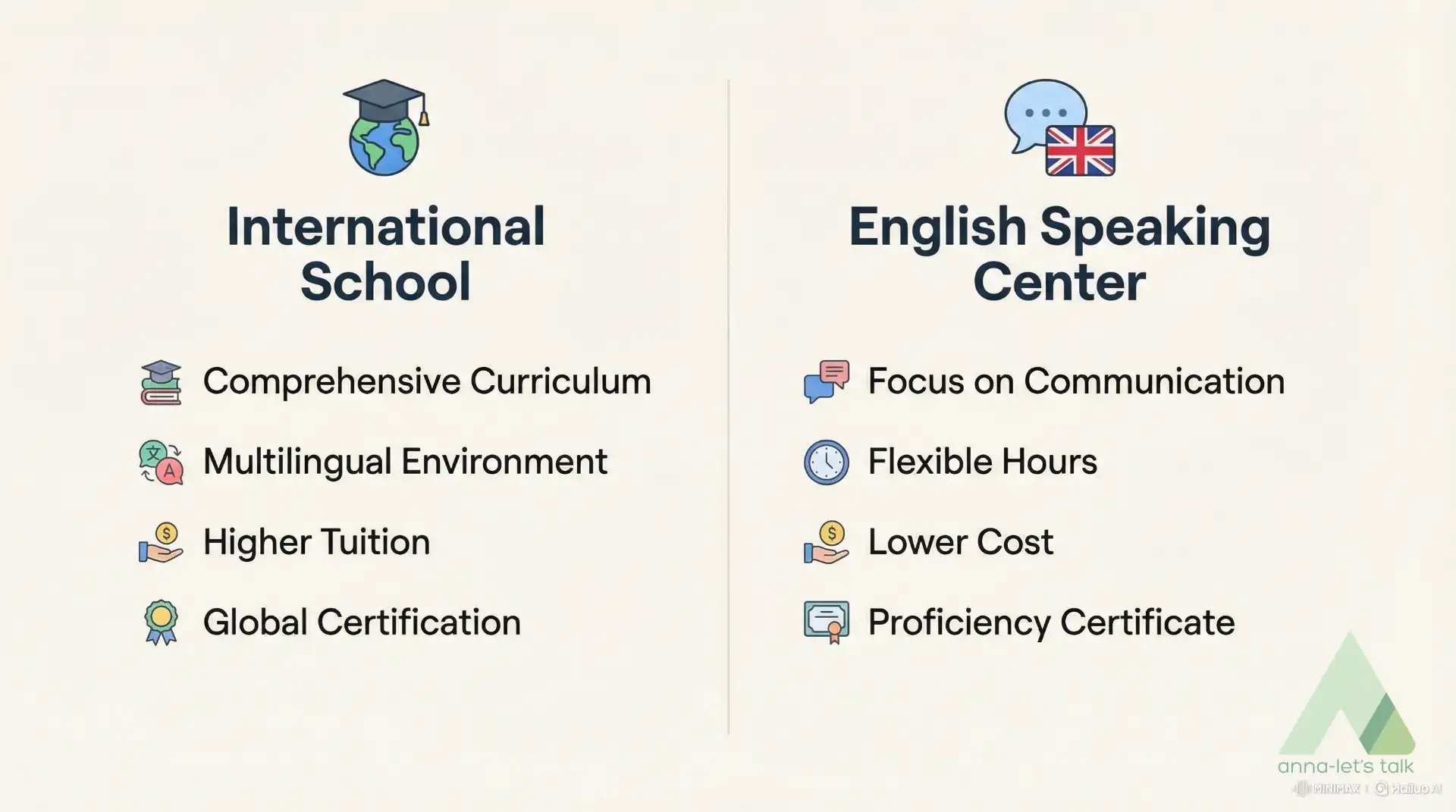
International School vs English Speaking Center
Both can help kids speak English, but they help in different ways.
| Feature | International School | English Speaking Center |
|---|---|---|
| Daily English exposure | High (all-day environment) | Medium (a few sessions per week) |
| Speaking time | Depends on classroom culture | Built for repeated speaking turns |
| Pronunciation focus | Varies by school/teacher | Often more targeted |
| Feedback rhythm | Term reports and checkpoints | Fast feedback each lesson/week |
| Best fit | Families ready for a full English school life | Families who want a speaking boost alongside school |
Some families use both: school for daily exposure, and a speaking class for confidence and clear pronunciation.
For a broader comparison of school life and center schedules, see international school vs language center in Nha Trang.
How Parents Can Support English Speaking at Home
You do not need perfect English. You need short, repeatable moments. Try 5-10 minutes at a time.
- Beach walk talk: name 5 things you see, then make one sentence.
- Cafe line: practice one order ("Can I have ___, please?") and let your child say it.
- Rainy-day retell: your child retells a short video in 3 sentences (First / Then / Finally).
- Scooter quick choices: "hot or cool?" "big or small?" fast answers build speed.
- Market mission (Chợ Đầm or local shop): one English "mission" before you go ("I want bananas.").
- Tourist-season hello: one polite line: "Hello. Have a nice day."
- One-sentence diary: after dinner, your child answers one question in one sentence.
- Mirror sound game: 60 seconds on one tricky word ("three," "street," "ice cream").
- English corner: 2 minutes of English only in one spot at home (feelings + requests).
Pick two ideas and repeat them for a month. That is how speaking becomes automatic. For more ideas, see English conversation practice in Nha Trang: a practical family guide. If your family is balancing two languages, see raising bilingual kids in Nha Trang beyond the classroom.

FAQ
What if my child is shy?
Shy kids can grow fast in the right class. Look for gentle pair work, clear routines, and praise that focuses on the message ("I understood you!"), not only the score.
How often should my child attend?
Most kids do well with two classes per week. If your schedule gets tight, keep one class and keep home routines short.
Does my child need a native-speaker teacher?
Not necessarily. Choose a teacher who coaches pronunciation clearly, gives lots of speaking turns, and corrects kindly and specifically.
My child mixes Vietnamese and English. Is that a problem?
It is normal. Your child wants to communicate. Help them replace one Vietnamese word at a time with English and keep the conversation moving.
How can I measure progress without tests?
Listen for speed and clarity: faster answers, longer chunks ("I think... because..."), and clearer pronunciation in repeated phrases.
What if my child feels tired after school?
That is common in Nha Trang. Choose a class with short speaking tasks and a calm routine. Keep homework light. Consistency matters more than intensity.
Gentle Closing + Soft CTA
Speaking grows in small wins: one clear sentence, one flexible answer, one brave try. When you watch a class, look for the Sandcastle cycle - Scoop, Shape, Build, Wave-Test, Snapshot. That cycle turns "I know English" into "I can speak."
If you would like to see this style of practice, you can read about our English speaking classes for kids in Nha Trang, then observe a session at Anna Let's Talk in Nha Trang or let your child try one class to feel the rhythm. No pressure - just a simple way to see if the environment fits your child.
And if you are still comparing English speaking classes Nha Trang kids can join, choose the place that gives your child more successful speaking moments every week. That is what changes everything.