
International School vs Language Center in Nha Trang: A Parent Guide
At 4:45 p.m., you stand near the school gate with a helmet in one hand and a snack in the other. Your child climbs onto the scooter, and you start doing the math in your head: tuition, commute time, homework, and how tired they already look. Later that night, you type international school vs language center Nha Trang into your phone and read opinions that pull you in opposite directions. You do not want the "best" on paper - you want the right fit for your child's confidence and real speaking.
International school vs language center Nha Trang: what are you really choosing?
Most parents are not choosing between "good" and "bad." They are choosing between two different weekly lives.
A more natural question sounds like this:
"Where will my child get enough English each week to speak comfortably - without burning out?"
In Nha Trang, your child's week often includes early school mornings, late-afternoon pickups, and a tight window before dinner. Some days you squeeze in swimming lessons; some weeks the rain hits hard and everyone just wants to get home. Even the drive along Trần Phú can feel longer when you rush to make a 6:00 p.m. class.
The common mistake parents make when comparing schools
Here is the counterintuitive truth: reputation and cost do not automatically create a confident speaker.
Many families assume an international school will "solve" English because the classroom runs in English. Other families assume a Language center Nha Trang program can only add vocabulary because it happens after school.
Speaking does not grow from labels. Speaking grows when your child talks often (not only listens), feels safe making mistakes, and gets clear feedback on pronunciation and meaning. If you want to understand why speaking time matters, see conversation English practice in Nha Trang.
A child can spend all day in an English environment and still stay quiet. Another child can attend two focused speaking classes a week and start talking more at home because someone finally helped them feel brave and understood.
The 4M Fit Lens
When parents ask me about an English school Nha Trang children can truly benefit from, I use one simple lens: the 4M Fit Lens. It helps you compare options without getting stuck on names.
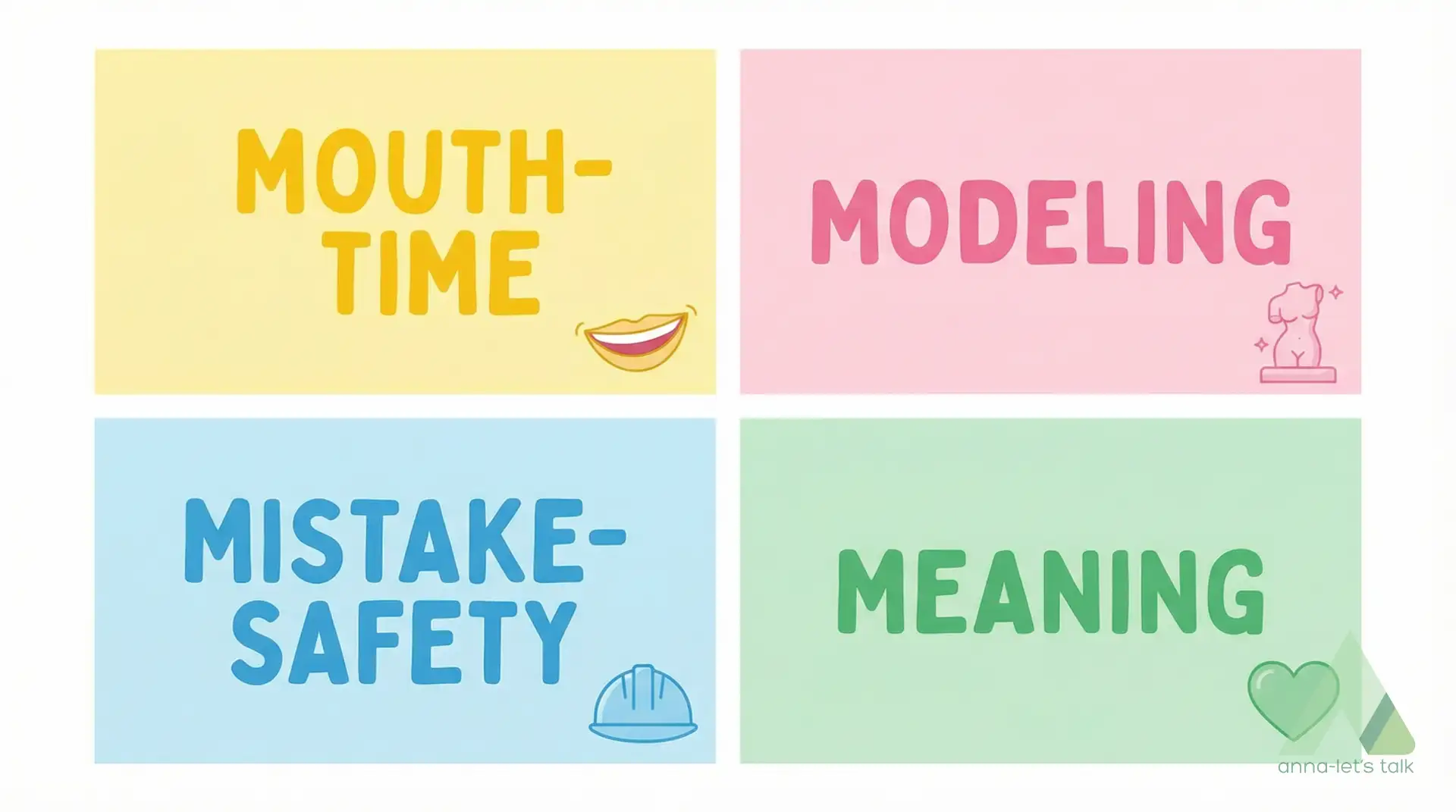
Mouth-time
How many minutes does your child actually speak in full sentences each week?
If your child mostly repeats or answers "yes/no," mouth-time stays low. If your child explains, asks, and role-plays, mouth-time rises fast.
Modeling
Who shows your child how English sounds and feels - stress, rhythm, and clear sounds?
Kids copy what they hear. They also need gentle correction (for example, "tree" vs "chree") before habits stick.
For a parent-friendly starting point, see how to improve English speaking for kids in Vietnam.
Mistake-safety
Does your child feel safe enough to try, sound "wrong," and try again?
Some children love big groups. Others need smaller groups and predictable routines before they speak.
Meaning
Does English help your child do something real - solve a problem, tell a story, negotiate rules in a game?
Meaningful talk builds confidence faster than perfect repetition.
Two quick Nha Trang decision scenarios
Scenario 1 (age 6): A Vietnamese family in Vĩnh Điềm Trung has a chatty first-grader who goes quiet in English. After school pickup, the child feels tired and impatient. Using the 4M Lens, the parents prioritize mistake-safety and short bursts of mouth-time rather than a long day that might overwhelm the child.
Scenario 2 (age 12): An expat family near the beach road plans to stay for two years. Their child reads well but avoids speaking in groups. They want an international curriculum Vietnam option for academics, but they also need consistent modeling for pronunciation and confidence. The 4M Lens helps them look for where that modeling will happen - inside school, outside school, or both.
What international schools typically offer
International schools usually offer a full-school-day environment where English supports academic learning across subjects. Families often value stable structure, continuity for expat moves, and a mixed-language community.
Your child may hear English all day in instructions, reading, group work, and presentations. That daily exposure can help language grow steadily.
At the same time, speaking confidence does not automatically appear. Class size, teaching style, and your child's personality decide how much mouth-time your child gets. Many children also switch to their strongest language with friends during breaks. Teachers often focus on academic outcomes, so they may not correct every pronunciation habit or coach every quiet child into speaking.

What English language centers typically offer
A language center usually works as a supplement. Many families choose it because it targets speaking and pronunciation in a flexible schedule - after school or weekends.
A strong center often gives more concentrated mouth-time in small groups, quick correction and clear modeling, and practice that feels like real interaction.
The main limit is time. Part-time hours cannot match a full-day environment for exposure. Progress also stays "inside class" if your child never uses English outside. And in Nha Trang, evening energy matters - some kids do great after school, while others crash by 6 p.m.

Comparison table: key differences
| Area | International school | English language center |
|---|---|---|
| Time commitment | Full school week; English across subjects | Part-time (evenings/weekends); focused sessions |
| Curriculum focus | Academics + language development | Speaking, pronunciation, conversation, targeted goals |
| Speaking practice opportunities | Can be daily, but varies by class and personality | Often high in-class speaking time, but fewer total hours |
| Cost structure | Larger term fees for full schooling | Add-on tuition beside regular schooling |
| Teacher interaction model | One teacher balances many needs (content + language) | Teacher focuses mainly on language and speaking habits |
| Feedback and assessment | Academic reports; language feedback may feel broad | Frequent, specific speaking-focused feedback |
How to decide what your child actually needs
Start with your child, not the label. These questions often bring quick clarity:
- What do I need most this year: academics, speaking confidence, or both?
- Which "M" is missing right now - mouth-time, modeling, mistake-safety, or meaning?
- Does my child speak more with adults or with peers?
- What schedule can we keep in real life? Think about the scooter commute, after-school activities, and rainy-season evenings.
- What will we still have energy for on Thursdays? The plan needs to survive a normal week.
When you visit or observe, watch for speaking signals:
- Do teachers invite quiet children to speak without pressure?
- Do students use full sentences, not only repetition?
- Do teachers correct pronunciation kindly and clearly?
One useful question for any provider: "How do you support a child who understands but will not speak?"
If you want a deeper look at class formats and schedules, see English speaking classes in Nha Trang for kids.
How parents can support either path
No matter which option you choose, home habits decide whether English becomes a real-life skill. Here are Nha Trang-friendly ways to support speaking without turning your house into a classroom:
- Keep a 5-minute daily chat right after school pickup: one story, one feeling, one detail.
- Use beach-walk English once a week: "I spy..." or "Tell me three things you see on the water."
- Use choice questions at home: "Now or in five minutes?" "Noodles or rice?"
- Make a rainy-day speaking jar with easy prompts for indoor evenings.
- Send 20-second voice notes in English to each other and reply warmly.
- Pick one pronunciation focus each week and practice it inside real phrases.
- Set up low-pressure play time where English can appear naturally with bilingual friends.
- Celebrate clarity, not perfection: "I understood you - that was clear."
- Protect sleep and rest so your child still has energy to speak.
These habits fit many English education options Nha Trang families consider because they work with real routines. For more ideas, see raising bilingual kids in Nha Trang beyond the classroom.

FAQ
Should I choose an international school if my child feels shy?
Shy children can succeed in any setting. Focus on mistake-safety and teacher support. A larger class may require extra encouragement or smaller speaking practice after school.
Can a language center replace an international school?
A language center usually cannot replace a full academic program. It can strengthen speaking, pronunciation, and confidence alongside your child's main school.
What if my child understands English but will not speak?
This happens often. Kids may fear mistakes or lack mouth-time. Look for routines and teachers who build safe speaking habits and give gentle, specific feedback.
Will my child lose Vietnamese in an international program?
Most children keep strong Vietnamese when families keep Vietnamese strong at home. Read, talk, and connect in Vietnamese daily, and support literacy as needed.
How many hours per week makes a difference?
Consistency matters more than a big number. Choose a routine you can keep and add small daily speaking moments at home.
Is it normal to combine both options?
Yes. Many families use a full-day school setting for academics and add speaking-focused practice for pronunciation and confidence.
Gentle closing + soft CTA
If you feel stuck on the international school vs language center Nha Trang choice, try one calming step: write down your child's 4M needs and match them to your family's weekly rhythm. Fit makes decisions easier.
If you want extra speaking support, see our English speaking classes for kids in Nha Trang at Anna Let's Talk, with practical conversation practice and attention to confidence and pronunciation. You can observe a class or try a session and see if the approach matches your child - no pressure.