English Conversation Practice Nha Trang: A Practical Family Guide
A few nights ago, my neighbor told me about a small moment at the Nha Trang Night Market. Their daughter saw a couple looking confused with a map. The mom nudged her gently. The girl understood the English question. She even knew the answer. But she stayed silent.
The father stepped in and said it for her, because the line behind them kept moving and the air felt hot and crowded. The couple smiled, thanked him, and disappeared into the lights and scooter noise.
On the walk home, the girl said one sentence that hit her parents hard: Child: "I wanted to say it, but I was scared."
If you live here, you have seen this scene in different places - on Trần Phú during summer tourist season, at Xóm Mới Market in the morning rush, or near the school gate at pickup time. The opportunity arrives fast, and it leaves fast. English conversation practice Nha Trang does not fail because families cannot find a place. It fails because kids miss the moment.

The Real Question
Parents ask, "Where to practice English Nha Trang?" because they want real conversation, not only textbook English.
I get it. But the real question sounds like this:
"How do we help our child speak English out loud today, inside the life we already live in Nha Trang?"
When you ask that, you stop waiting for the perfect chance. You start creating small speaking chances that repeat. Your child practices their way into confidence.
What Parents Get Wrong About "Finding Practice"
They wait for a big, impressive conversation
Most real interactions here last under 30 seconds: ordering, greeting, asking one question, saying thank you. Kids do not need long talks to grow. They need many short starts.
They speak for their child to be polite or fast
In a busy city, parents move quickly. During peak months (June to August), sidewalks feel packed along the beach road. So parents answer for their child to save time.
Your child learns a quiet lesson: "Adults speak. I watch."
A small change fixes this: let your child handle the first line. Even one sentence changes the story.
Child: "Hello! Can you help me, please?"
They treat mistakes like danger
Many parents wait until their child can speak correctly. They want good grammar and clear pronunciation first.
Here is the counterintuitive truth: imperfect, short conversations build confidence faster than waiting for perfect opportunities.
A child who says, "Two ticket, please," still practices courage. You can polish grammar later. You cannot polish silence.
They push kids into surprise speaking
If you suddenly say, "Go talk to that foreigner," your child may freeze. Kids do not refuse English. They refuse pressure.
Kids need a predictable habit, not random challenges.
The Say-Three Conversation Habit Mindset
This is the habit mindset I recommend to local families: the Say-Three Conversation Habit Mindset.
Say-Three = your child speaks three complete English sentences in real life every day. Not three minutes. Not a perfect chat. Just three sentences.
Why three? It feels small enough to start, but big enough to matter. And it forces voice, not only understanding.
What counts as a "Say-Three" day
Your child can use a simple shape:
Open → Purpose → Close
At a drink stall:
- Child: "Hi!"
- Child: "Can I have one mango smoothie, please?"
- Child: "Thank you!"
Outside school:
- Child: "Good afternoon!"
- Child: "Today I have soccer class."
- Child: "See you tomorrow!"
Your job as the parent
- Before you leave home, choose one likely speaking moment.
- Give your child one starter line.
- Let them finish. Do not rescue too early.
- Do a two-minute reflection later.
Reflection keeps the habit moving forward. Ask one question: "Which word felt hard?" Then practice that one word once.
If you want an easy home warm-up that takes five minutes before you go out, start with raising bilingual kids in Nha Trang beyond the classroom.
The Nha Trang Conversation Reality
Nha Trang offers lots of English exposure - but it does not always look like practice.
- Tourist season brings more English, especially around Trần Phú, the beach walkway, and popular photo spots.
- Rainy season brings fewer random chats, but it gives you consistent micro-moments in buildings, shops, and elevators.
- Most interactions stay short. People shop, walk, and move. Kids rarely get long conversations, and that is okay.
When you aim for English speaking practice Nha Trang, do not chase long talks. Chase repeatable starts.
How Confidence Is Built Through Small, Real Attempts
Confidence grows through micro-bravery. Your child tries, survives the awkward second, and realizes nothing bad happens.
Scenario 1: The market helper moment
You stop at Xóm Mới Market for fruit. You give your child one job: ask the price in English. Your child looks at the fruit and says: "Excuse me, how much is this?" Maybe the seller answers in Vietnamese. Your child still wins, because they started. You help the close: "Thank you!"
On the ride home, you reflect for two minutes: "Your 'excuse me' sounded clear. Tomorrow, let's try 'How much for one kilo?'"
This is practice speaking English kids Vietnam can repeat without fear.

Scenario 2: The beach photo moment
Near Hòn Chồng at sunset, a visitor struggles to take a photo. Your child can help without needing advanced English. They step forward and say: "Hi! Do you want me to take a photo?" After they take the photo: "Here you go. Have a nice day!" That is a real conversation. It is short, imperfect, and powerful.
Everyday Conversation Routines (patterns, not tips)
Families do not win with motivation. They win with routines that happen anyway.
Choose two routines and repeat them. Let your child collect Say-Three sentences inside each routine.
The school-gate routine
School gates feel familiar, so kids speak more easily.
Your child can greet a teacher, a friend's parent, or even you while you wait:
- Child: "Good afternoon!"
- Child: "I have homework today."
- Child: "See you later!"
The order-and-confirm routine
After school, many families grab a quick snack or drink because the heat hits hard in the afternoon.
Let your child order one item every time:
- Child: "Hello!"
- Child: "Can I have coconut water, please?"
- Child: "No ice, please. Thank you!"

The one-question walk routine
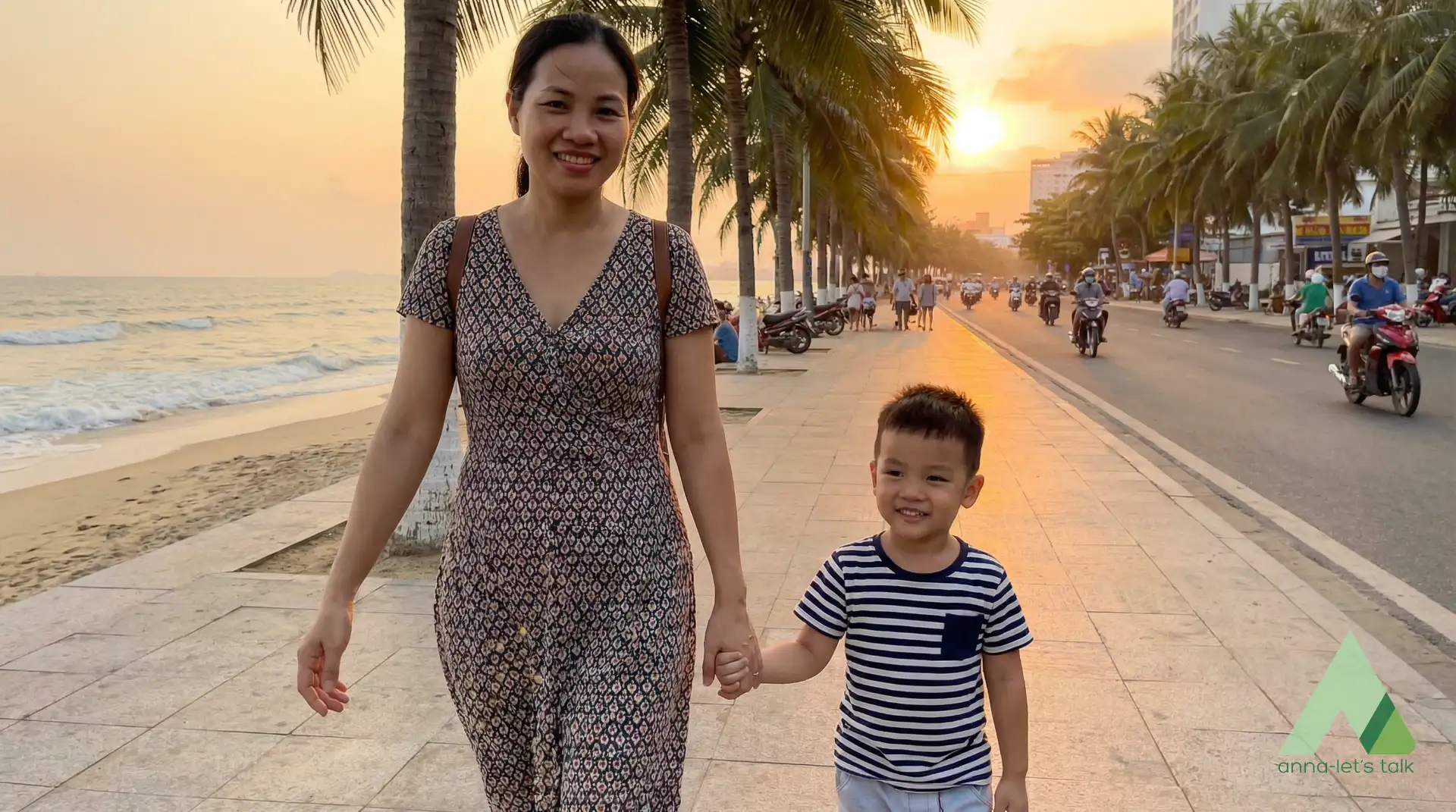
Use a beach walk on Trần Phú, a quick stop near a market, or a short stroll after dinner. Aim for one friendly question.
If your child talks to a visitor:
- Child: "Hi! Is this your first time in Nha Trang?"
- Child: "What food do you like here?"
- Child: "Nice to meet you. Bye!"
If no visitor feels safe that day, your child can ask you the same questions. The habit still counts because the child speaks.
For a gentle pronunciation check that keeps your child understood in these short chats, use the quick activity in how to improve English speaking for kids in Vietnam.
Making the Most of Any Speaking Moment
Some days, you will not plan anything. A moment will appear suddenly. Keep one simple rule:
Help your child start → stay quiet → reflect later.
Start with a bridge sentence your child can always use:
Child: "Hi! Can I ask you a question?"
If your child gets stuck, do not jump in with a long explanation. Offer one rescue line:
Child: "Sorry, I'm learning English."
Then reflect at home with one tiny upgrade. If your child said "smoothie" unclearly, practice it once:
Child: "Smoothie."
That is enough. Save the rest for tomorrow.
FAQ
What if my child freezes every time?
Lower the risk. Begin with the same sentence in the same situation for a week.
Example at a shop:
Child: "Hello. One water, please."
When that feels easy, add a close:
Child: "Thank you!"
What if people do not answer in English?
Your child still practiced the start, which matters most.
Give your child a confident ending:
Child: "Thank you. Have a nice day!"
The goal is speaking, not controlling the other person.
Should I correct every mistake right away?
No. Corrections can crush momentum.
Choose one correction per day. Model it once and let your child repeat once.
Child: "He go to the beach."
Parent: "He goes to the beach."
Child: "He goes to the beach."
How do I help with pronunciation without turning it into a class?
Use "one word, one time." Pick the one word that blocked understanding, then practice it once after the moment. Keep it light.
Child: "Beach."
My child speaks in class, but not outside. Why?
Outside feels unpredictable. Class feels safe. That is why a habit mindset works. Say-Three gives your child a small, repeatable script that travels with them.
Gentle Closing + Soft CTA
If you want Conversation English Nha Trang to feel real for your child, do not wait for a perfect event. Build a daily habit. Remember the counterintuitive truth: short, imperfect conversations build confidence faster than waiting for perfect opportunities.
Try Say-Three for 14 days. Help your child speak three sentences each day in normal life - at the school gate, during a snack order, on a beach walk, or on a rainy day in your building.
When your child collects real-life attempts, they can refine them. That is where Anna Let’s Talk fits naturally: we support kids as they polish pronunciation, build clearer sentences, and reflect on real moments - so the next small conversation feels easier. If you want to see our English speaking classes for kids in Nha Trang, that page gives a quick overview. For a deeper guide, see English speaking classes in Nha Trang for kids.